
Wealth Insights
Afraid to Invest a Lump Sum? Why Time Horizon Matters More Than Timing
3 minute read time
Having a large cash balance to invest can be a welcome opportunity, but I’ve seen clients struggle with difficult emotional decisions as a result. Whether the money came from an inheritance, bonus, business sale, maturing certificate of deposit or accumulated savings, many investors hesitate because they fear investing immediately before a market decline. When markets are at or near all-time highs as they are now, fears of “buying high” may be more pronounced than usual.
While this concern is understandable, it can lead to an overly conservative choice. Holding cash may avoid the discomfort of seeing an account decline in the near term, but it also delays exposure to the long-term return potential of a diversified portfolio.
A better way to frame a lump-sum decision is to separate short-term discomfort from long-term goals. If the money may be needed soon, it generally should not be exposed to meaningful volatility; if it is intended for long-term goals, short-term market movements should not dictate the decision to invest. Instead, investors should deploy cash after considering the purpose and time horizon of the investment and working with an advisor to choose an asset allocation within the context of a sound financial plan.
A Reasonable Time Horizon May Help Reduce Risk
I used to use the chart below to help clients gauge their risk tolerance. It shows the best, worst and average calendar-year returns for a given mix of stocks and bonds from 1926-2025. As you might guess, the 100% bond portfolio has a much smaller worst case historically (-13%) than a 100% stock portfolio (-43%). The latter number might frighten an investor with cash, keeping them from getting started or allocating enough assets to equities to meet their investing goals.
Figure 1: Historical range of calendar-year returns across stock and bond allocations, 1926-2025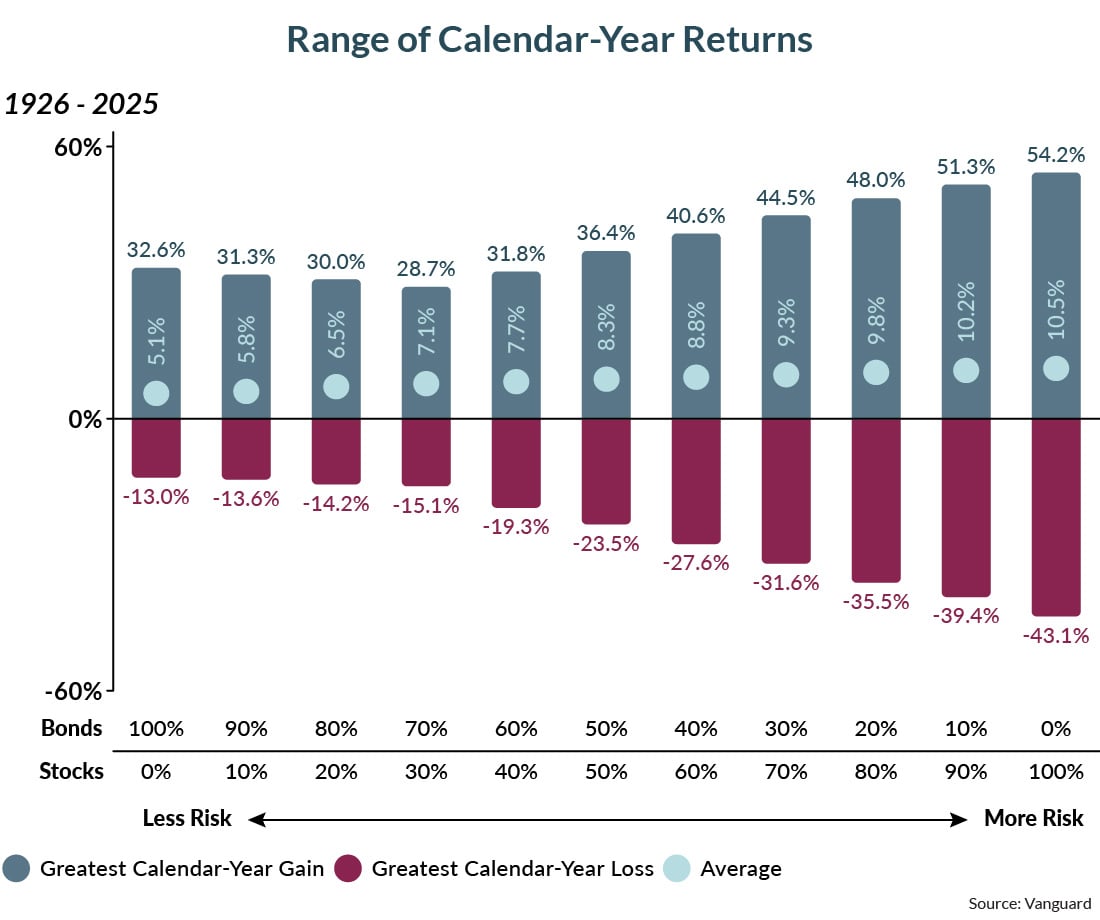
But, with experience, I learned that using only calendar-year returns may overstate the practical risk for long-term capital. A single bad calendar year is a real possibility, but it is only one slice of the investor experience; risk should also be assessed by how outcomes improve as the holding period lengthens and whether the investor has enough liquidity to avoid selling during temporary declines.
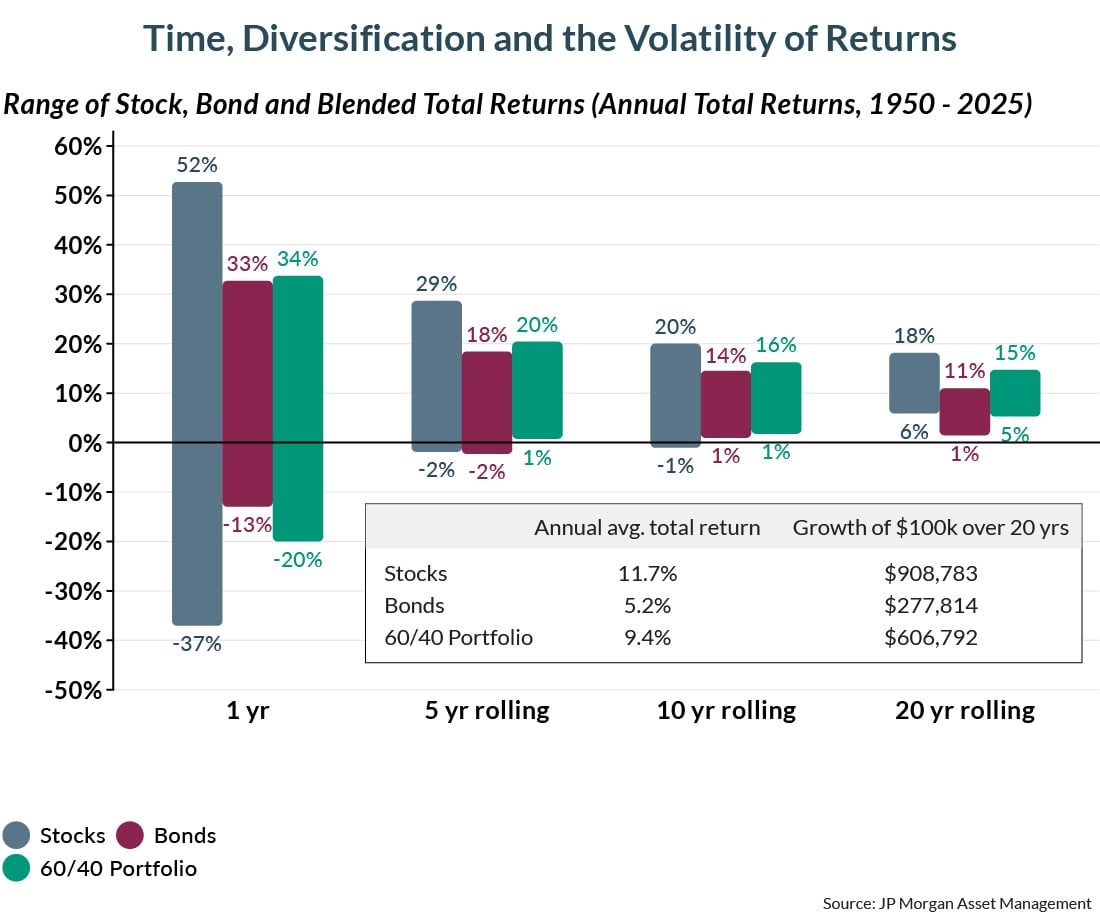
That context becomes more useful when paired with the longer-horizon evidence below. Calendar years show how uncomfortable short-term losses can be, while rolling-period returns show why a one-year worst case should not be the sole measure of risk for money intended to remain invested for many years. Historically, the range of outcomes, and risk of loss, has narrowed substantially over five-, ten- and twenty-year periods. Historically, the worst rolling twenty-year result was positive for stocks, bonds and a balanced 60/40 portfolio. If you can’t commit to a five-year investment horizon, you probably shouldn’t be investing in equities. If your horizon is 20 years or more, equities may play an important role in meeting your long-term goals.
Figure 2. Historical ranges of stock, bond and balanced-portfolio returns over longer rolling periods
What About Dollar Cost Averaging?
No strategy can prevent a portfolio from declining shortly after money is invested, but dollar cost averaging, or investing a fixed amount of money at regular intervals such as weekly or monthly, regardless of market ups and downs, is a common way to help clients avoid the potential regret of poor timing. With dollar cost averaging, you automatically buy more shares when prices are low and fewer shares when prices are high. This is an appealing and reasonable approach employed by many advisors. Interestingly, however, the research shows that investing all at once has historically produced higher returns more often.
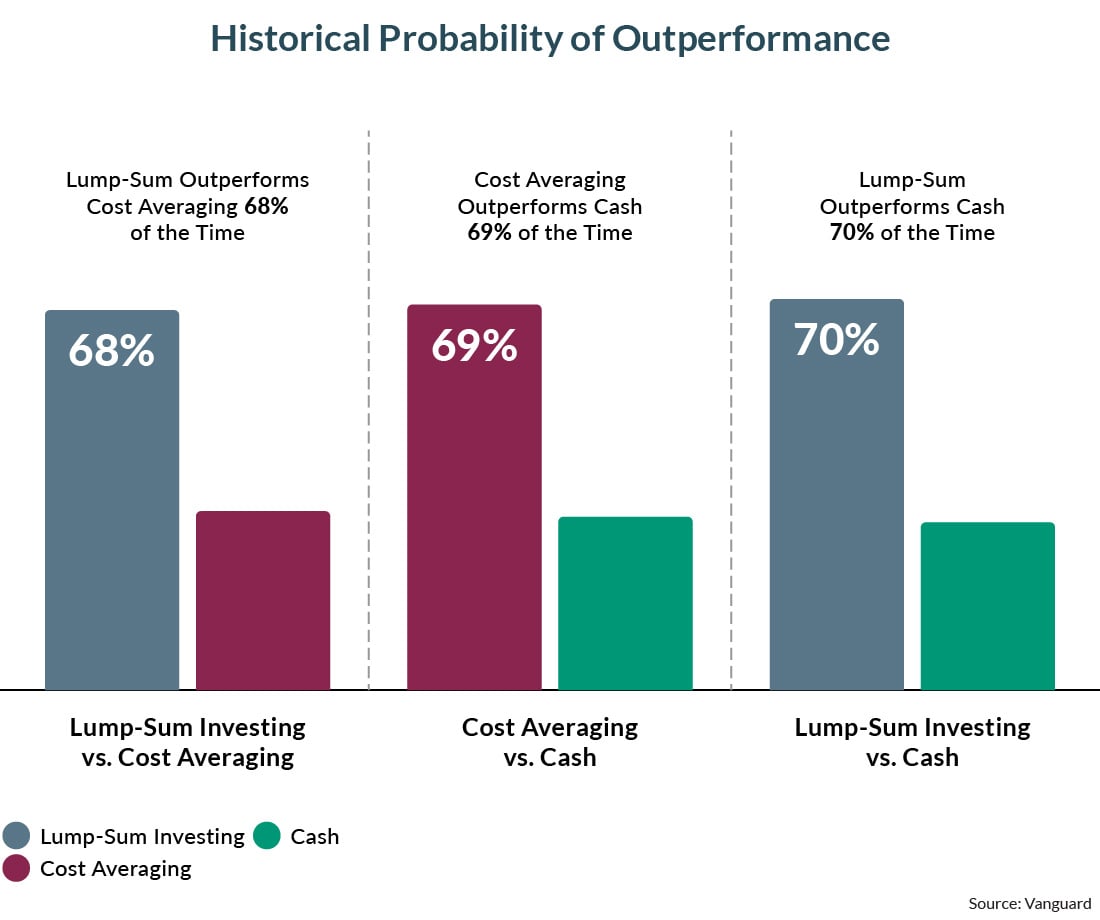
Vanguard research from the period 1976-2022 found that lump-sum investing beat a 3-month dollar cost averaging approach roughly two-thirds of the time over a 1-year horizon. In the hypothetical $100,000 examples below, median one-year ending wealth was higher when the money was invested immediately across growth, balanced and conservative allocations. Dollar cost averaging over longer periods, extending the time to get fully invested, generally resulted in a greater performance disadvantage.
Figure 3: Historical hypothetical wealth ranges for lump-sum vs dollar cost averaging strategies after one year investment period.
| Portfolio | Lump Sum | Cost Averaging | Advantage |
| 100% equity | $111,940 | $109,580 | $2,360 |
| 60% equity / 40% bond | $109,360 | $107,453 | $1,907 |
| 40% equity / 60% | $107,648 | $106,400 | $1,248 |
Source: Vanguard
This does not mean lump-sum investing always wins. It means dollar cost averaging is a risk-management and behavior-management tool, not automatically the highest-probability return strategy when new long-term cash is available.
Notably, Vanguard’s research also showed that dollar cost averaging beat simply holding cash 69% of the time. Getting started is better than doing nothing waiting for an all-clear sign that will never come.
Figure 4: Historical probability of outperformance among lump-sum investing, cost averaging, and cash
Do All-Time Highs Matter?
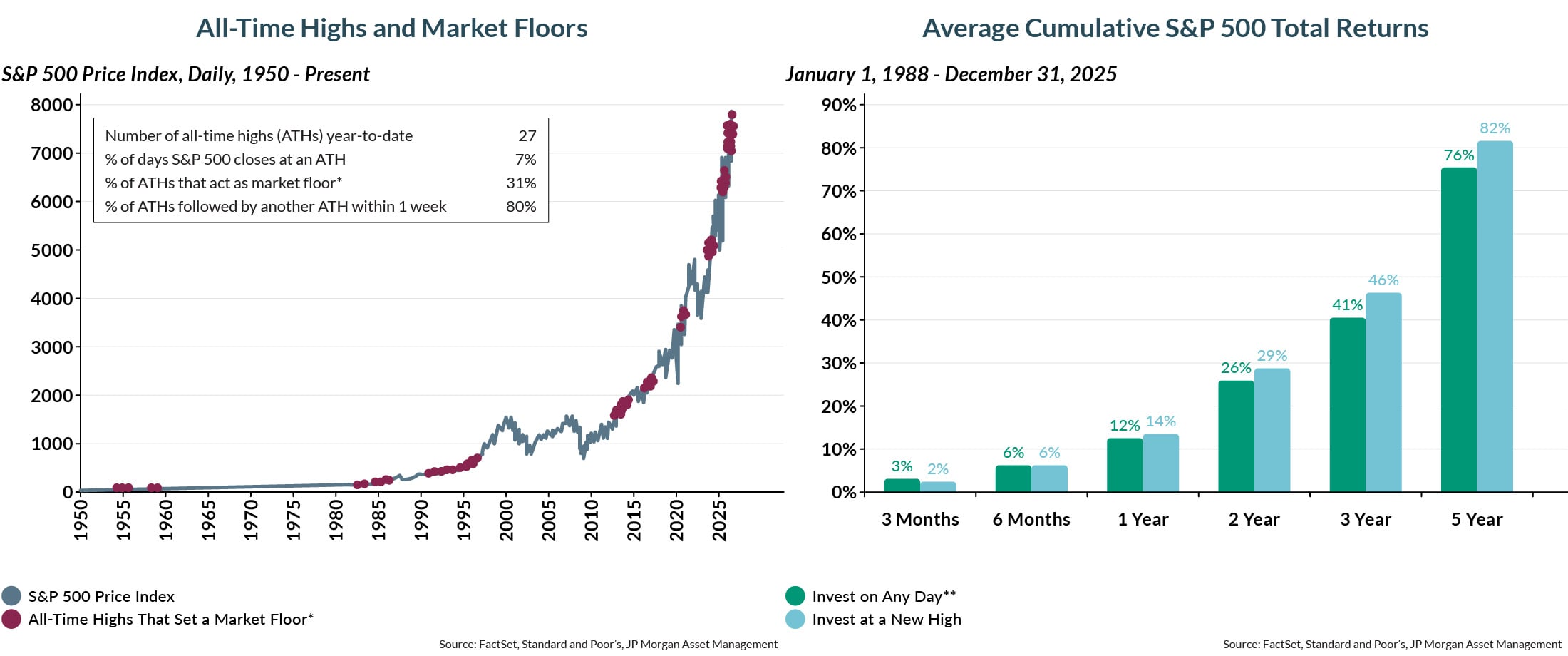
One common reason investors hesitate to deploy cash is that the market may be near an all-time high. Yet, as the research shows, all-time highs are not rare anomalies. They are a normal result of long-term market growth, and they often occur in clusters.
The chart below shows that, since 1950, 31% of S&P 500 all-time highs established a market floor, meaning the index did not later fall below that level. It also shows that 80% of all-time highs were followed by another high within one week. Investors waiting for a meaningfully better price did not always receive one.
The companion return comparison reinforces the point. From January 1988 through December 2025, average cumulative returns after investing at a new high were broadly comparable to, and over several longer horizons higher than, returns after investing on any day. A new high cannot prevent a decline, but the high itself has not been a reliable signal to remain in cash.
Figure 5. S&P 500 all-time highs, market floors and average forward returns after new highs
Make a Plan and Stick to It
When I started this business, I assumed that institutional access to the best research from the best minds in finance would help me know when to deploy cash or keep reserves for a better entry point. Many years later, I realized that some investment research and short-term market forecasts can be marketing presented as expertise.
As the data we have reviewed shows, for investors sitting on new cash, the most important thing is to begin with purpose and time horizon rather than market timing. A deep conversation with your financial planner about your specific goals will determine the correct asset allocation and make sure there is sufficient cash for emergency reserves, near-term spending, taxes and known liabilities.
When you have a plan, then it’s time to invest. Choose an approach, whether it’s dollar cost averaging over a short schedule or investing a lump sum, and stick to it. For cash that is long-term, history suggests that a suitable allocation, sufficient time and staying invested have done more to manage risk than waiting for the perfect entry point. For investors worried about short-term losses, the key question is not whether markets might fall after they invest, but whether the money has enough time to recover and compound.
This information is for educational and illustrative purposes only and should not be used or construed as financial advice, an offer to sell, a solicitation, an offer to buy or a recommendation for any security. Opinions expressed herein are as of the date of this report and do not necessarily represent the views of Johnson Financial Group and/or its affiliates. Johnson Financial Group and/or its affiliates may issue reports or have opinions that are inconsistent with this report. Johnson Financial Group and/or its affiliates do not warrant the accuracy or completeness of information contained herein. Such information is subject to change without notice and is not intended to influence your investment decisions. Johnson Financial Group and/or its affiliates do not provide legal or tax advice to clients. You should review your particular circumstances with your independent legal and tax advisors. Whether any planned tax result is realized by you depends on the specific facts of your own situation at the time your taxes are prepared. Past performance is no guarantee of future results. All performance data, while deemed obtained from reliable sources, are not guaranteed for accuracy. Not for use as a primary basis of investment decisions. Not to be construed to meet the needs of any particular investor. Asset allocation and diversification do not assure or guarantee better performance and cannot eliminate the risk of investment losses. Certain investments, like real estate, equity investments and fixed income securities, carry a certain degree of risk and may not be suitable for all investors. An investor could lose all or a substantial amount of his or her investment. Johnson Financial Group is the parent company of Johnson Bank and Johnson Wealth Inc. NOT FDIC INSURED * NO BANK GUARANTEE * MAY LOSE VALUE
ABOUT THE AUTHOR